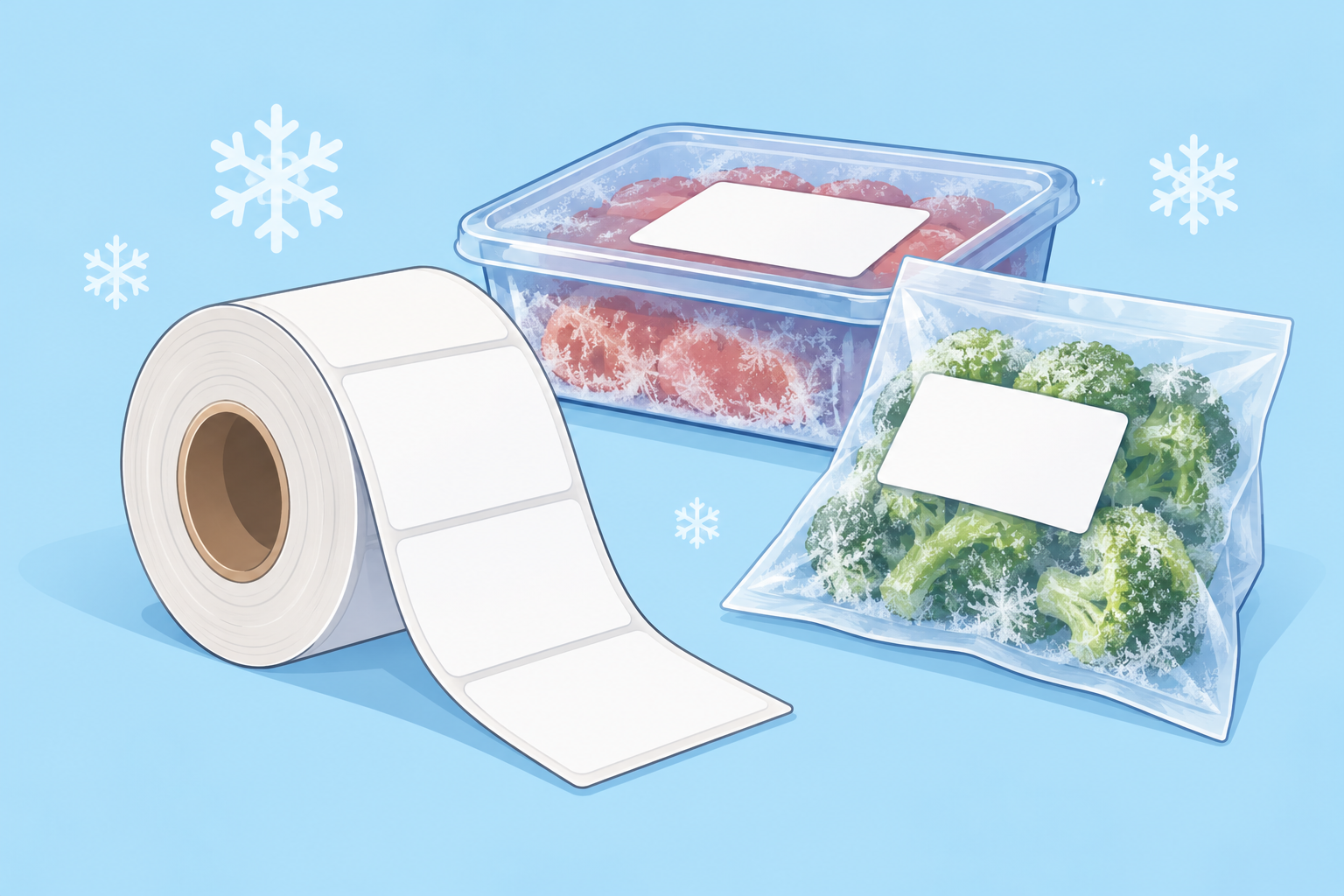
A standard label soon peels off in the freezer, starts to curl or becomes unreadable because of condensation. Freezer-safe labels are made for exactly this: they keep sticking down to -20°C and the text stays readable. In this article we explain what these labels can do, how to use them properly and which sizes we offer for Dymo, Brother and Zebra.
Why standard labels do not work in the freezer
Paper labels absorb moisture. In the freezer, moisture settles as condensation or frost, which softens the paper and makes the adhesive lose its grip. Ordinary adhesive also turns hard in the cold and lets go. The result: labels that fall off the product, or text that fades just when you need it.
What makes freezer labels different?
- Plastic instead of paper – the labels are made of polypropylene (PP), a film that does not absorb moisture and does not tear.
- Special adhesive – a permanent hot-melt adhesive that keeps sticking in the cold and in damp conditions.
- Waterproof, resistant to oil and plasticizers – wet hands, grease or plastic packaging are no problem.
- Readable text – the print stays sharp, even when the label gets wet or steamed up.
- Ordinary thermal printing – you do not need ink, ribbon or toner.
How to use freezer labels properly
- Apply the label to a dry surface, free of frost or ice.
- Apply the label at -15°C or warmer. That is the lowest temperature at which the adhesive still bonds well.
- Press the label down firmly, especially along the edges.
- Apply the label before the product goes into the freezer. After that it stays put down to -20°C.
The values mentioned come from laboratory tests and are for reference only. In unusual conditions, always test the label on the material you are going to use it on.
Who are freezer labels useful for?
- Catering and meal prep – meals and portions with a name and date on them.
- Butchers and fishmongers – products that go into the freezer.
- Frozen and cold storage warehouses – boxes, crates and shipping labels for frozen shipments.
- Laboratories and healthcare – samples stored at -20°C.
Our freezer-safe labels
All labels below use the same PP film and adhesive. Click a label for the price and availability. The Dymo labels fit LabelWriter printers (except the 550 and 5XL), the Zebra labels fit a suitable label printer for that size. The Brother labels fit QL label printers.
| Label | Printer | Labels per roll |
|---|---|---|
| Dymo 99010 – 28 × 89 mm | Dymo LabelWriter | 260 |
| Dymo 99012 – 36 × 89 mm | Dymo LabelWriter | 260 |
| Dymo 11352 – 25 × 54 mm | Dymo LabelWriter | 500 |
| Dymo 11354 – 57 × 32 mm | Dymo LabelWriter | 1000 |
| Dymo 99014 (PP) – 101 × 54 mm | Dymo LabelWriter | 220 |
| Brother DK-22205 – 62 mm × 30,48 m | Brother QL | 30,48 m |
| Zebra 57 × 32 mm | Zebra | 1500 |
| Zebra 76 × 51 mm | Zebra | 1370 |
| Zebra 102 × 76 mm | Zebra | 930 |
Frequently asked questions
How cold can it get?
Down to -20°C, so an ordinary deep freezer. These labels are not intended for extremely low temperatures, such as -80°C in laboratories.
Can I stick the label on an already frozen product?
We advise against it. The label must be applied at -15°C or warmer, on a dry surface. No label bonds well to an ice-cold product covered in frost. So label before freezing.
Does the text stay readable when the label gets wet?
Yes. The PP film does not absorb moisture, so the print stays sharp, even with condensation.
Ready to get started? View all labels for your printer: