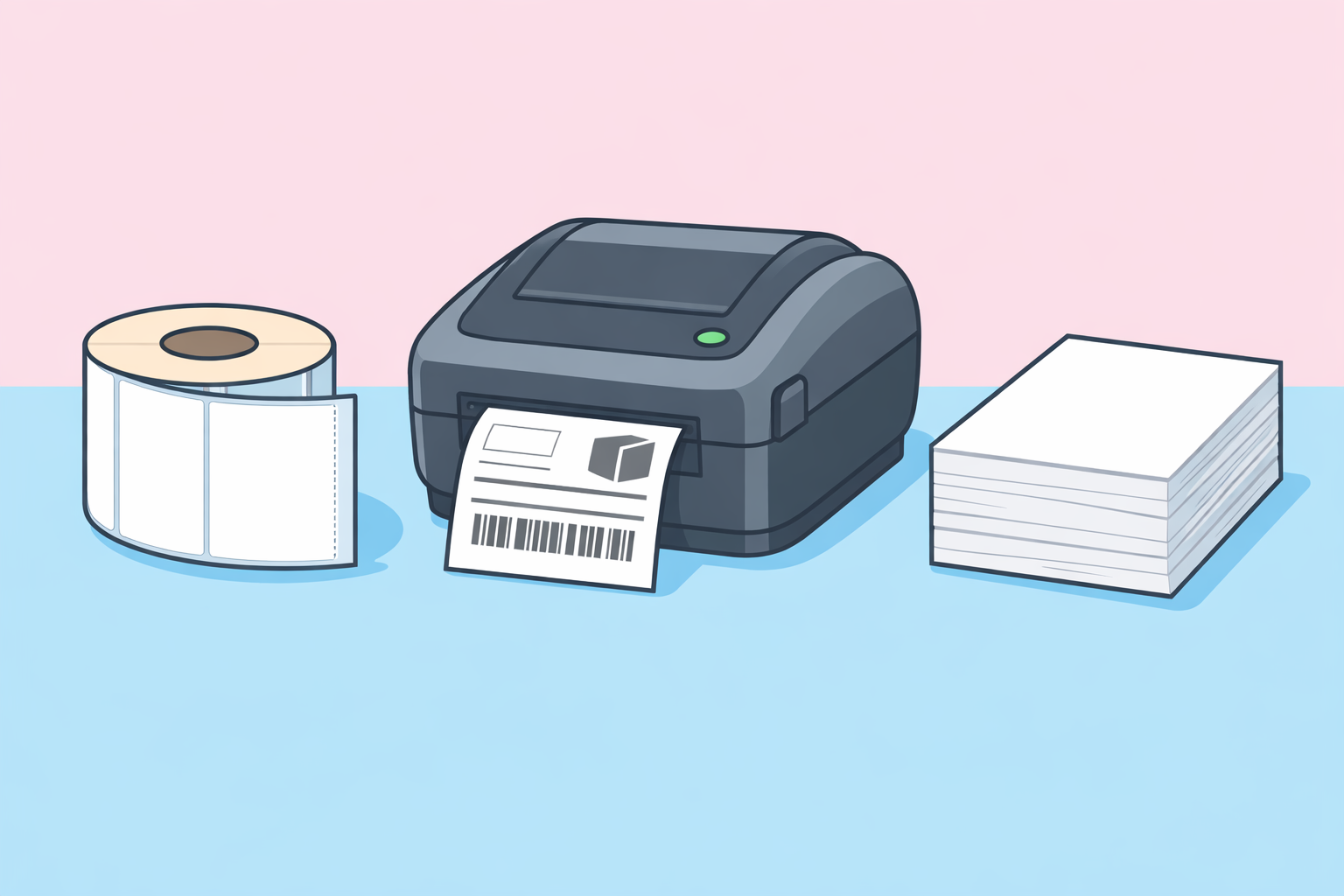
Anyone who prints shipping labels regularly will eventually face the same question: should you choose labels on a roll or fanfold labels? Both options are suitable for printing shipping labels, but they differ clearly in ease of use, storage, feeding method and capacity. The best choice depends on your printer, your workspace and the number of labels you print each day.
In this article, we explain the difference between roll labels and fanfold labels, compare their advantages and help you determine which solution best fits your situation.
What are roll labels?
Roll labels are labels wound onto a roll. They are placed inside or behind the label printer and feed through the printer automatically during printing. For many users, this is the most familiar label format.
For shipping applications, 102 x 150 mm is a commonly used format. Within that size, several options are available, such as thermal labels 102 x 150 mm - 300 labels, thermal labels 102 x 150 mm - 500 labels and Zebra labels 102 x 150 mm - 900 labels.
What are fanfold labels?
Fanfold labels are not supplied on a roll, but as folded labels stacked in a zigzag pattern. Instead of placing a roll in the printer, you feed the stack of labels through the rear or external media feed of the printer.
Fanfold labels are often chosen for higher print volumes or when users prefer not to work with a roll holder. They are also a practical solution for fixed workstations where many shipping labels are processed.
For this type of application, for example, fanfold shipping labels 100 x 150 mm and fanfold shipping labels 102 x 152 mm are relevant options.
What is the difference between roll and fanfold labels?
The main difference lies in how the labels are fed into the printer. With roll labels, the printer gradually unwinds the roll during printing. With fanfold labels, the printer pulls the labels from a folded stack.
That may seem like a small difference, but in practice it affects:
- the amount of space available around the printer
- the number of labels you can print consecutively
- the loading method
- suitability for specific printer models
Advantages of labels on a roll
Compact and neatly stored
A roll takes up little space and stays neatly together. This makes roll labels suitable for smaller workspaces, counters and desks.
Easy to use
For printers designed for labels on a roll, loading is usually quick and simple. For many users, this is the most familiar way of working.
Available in different quantities
Roll labels in 102 x 150 mm are available in several quantities per roll. This allows you to match your label supply more closely to your usage and workflow, whether you print occasionally or process larger volumes every day.
A logical choice for daily shipping
For many standard shipping applications, roll labels are a practical and efficient solution, especially when your printer is specifically designed for rolls.
Advantages of fanfold labels
No roll holder required
Because the labels are folded into a stack, there is no roll that needs to turn. This can be useful for printers that support fanfold feeding through the rear input.
Practical for higher volumes
For larger quantities of shipping labels, fanfold can be convenient because the labels are stacked and ready for continuous use.
Less changing during operation
Depending on your workflow, fanfold can be a logical choice when you print labels continuously and want as few interruptions as possible while processing parcels.
Useful for fixed workstations
In warehouses, fulfilment environments and shipping departments where the printer stays in a fixed location, fanfold can be very efficient.
When should you choose labels on a roll?
Labels on a roll are usually the best choice if you:
- have a compact workspace
- use a printer that is primarily designed for rolls
- want a simple and familiar loading method
- print a limited to average number of labels per day
- want to choose between different roll quantities
That makes roll labels the safest choice for general day-to-day use in many cases.
When should you choose fanfold labels?
Fanfold labels are often more interesting if you:
- have a printer that supports fanfold feeding
- print many shipping labels consecutively
- work from a fixed shipping or warehouse station
- prefer working with a loose stack of labels rather than rolls
- want the feeding process to remain as practical as possible at higher volumes
Which label type fits your printer?
Not every label printer works in the same way. Some printers are mainly intended for rolls, while other models also support fanfold labels via the rear or external media feed.
Always check:
- which media size your printer supports
- whether fanfold feeding is possible
- whether the chosen label type is properly recognized by the printer
- whether the label material matches your application
Do you use a printer for standard shipping labels in 100 x 150 mm, 102 x 150 mm or 102 x 152 mm? Then it is wise to look not only at the label size, but also at the feeding method that best matches your printer and workflow.
What is the best choice for shipping labels?
There is no universal best choice for shipping labels. The right solution depends on how you work.
Do you print labels occasionally or want a compact solution for your desk? Then roll labels are usually the most practical option.
Do you print large quantities at a fixed workstation and does your printer support fanfold feeding? Then fanfold labels may be the more efficient choice.
So the decision is not only about the label size, but above all about ease of use, printer compatibility and print volume.
Our tip: do not only look at size, but especially at your workflow
Many users choose labels based solely on size, for example 102 x 150 mm. That is understandable, but the label format is at least as important. Two labels can have the same size, yet work very differently in practice because one is supplied on a roll and the other in fanfold format.
If you print shipping labels regularly, choosing correctly in advance can save a lot of time.
Conclusion
Both labels on a roll and fanfold labels are suitable for printing shipping labels, but each has its own advantages.
Choose roll labels if you want a compact, accessible and versatile solution.
Choose fanfold labels if you work with higher volumes and have a printer that properly supports this feeding method.
Still unsure which option to choose? Then look at three things: your printer, your available workspace and the number of labels you print each day. Based on that, the right choice usually becomes clear quickly.